Spotify and revenue per stream
Matt Bircher has a great series of posts on music streaming and revenue per stream. It’s largely a response to a post by Brian Merchant, which I also saw saw and wanted to (but likely never would have!) comment on.
I completely agree with Matt on the point that absolute revenue is far more important than revenue per stream, which in any case is not a uniform metric that lends itself to direct comparison.
This reminds me of people in relatively high paying jobs being disgruntled about being paid less than the minimum wage, when they ultimately enjoy much higher disposable incomes than most people (and likely significantly better future prospects). It’s by no means a good analogy, but I’d argue that said people wouldn’t swap their jobs for a higher hourly rate any more than unhappy musicians would forgo the Spotify revenue which makes up the bulk of their streaming income to focus on the other services with a higher ‘revenue per stream’.
Regardless, the actual point I wanted to address was Matt commenting on how Spotify’s business model has been bad for musicians.
I don't like Spotify either and I would agree that the business model it pioneered has represented a massive reduction in direct value most artists get from the raw musical output they create. After all, I grew up in the 90s when a new CD routinely cost like $17 from the local music store, which is about $33 in today's money.
I also spent the back half of the 90s using all of my (meagre) disposable income to buy CD singles and albums. But I also remember going to university in the early 2000s and downloading GBs of music on Napster ‘for free’. And I’m fairly sure that it was that shift to (purely) digital music and online piracy which actually really led to the massive reduction in music revenue.
(The) iTunes (Store) is often framed as the saviour of music, as it pioneered the sale of 99c singles, which (in conjunction with iPods) proved to be a very convenient alternative to pirating music tracks. However, it was iTunes unbundling of the album which made it possible to cherry pick the best songs on an album for a fraction of the price of the complete record. iTunes was obviously far better than piracy, but it was ‘only’ make a making a bad problem less worse. This can be seen on the chart below where total music industry revenue reached its nadir during the MP3 dominated era.
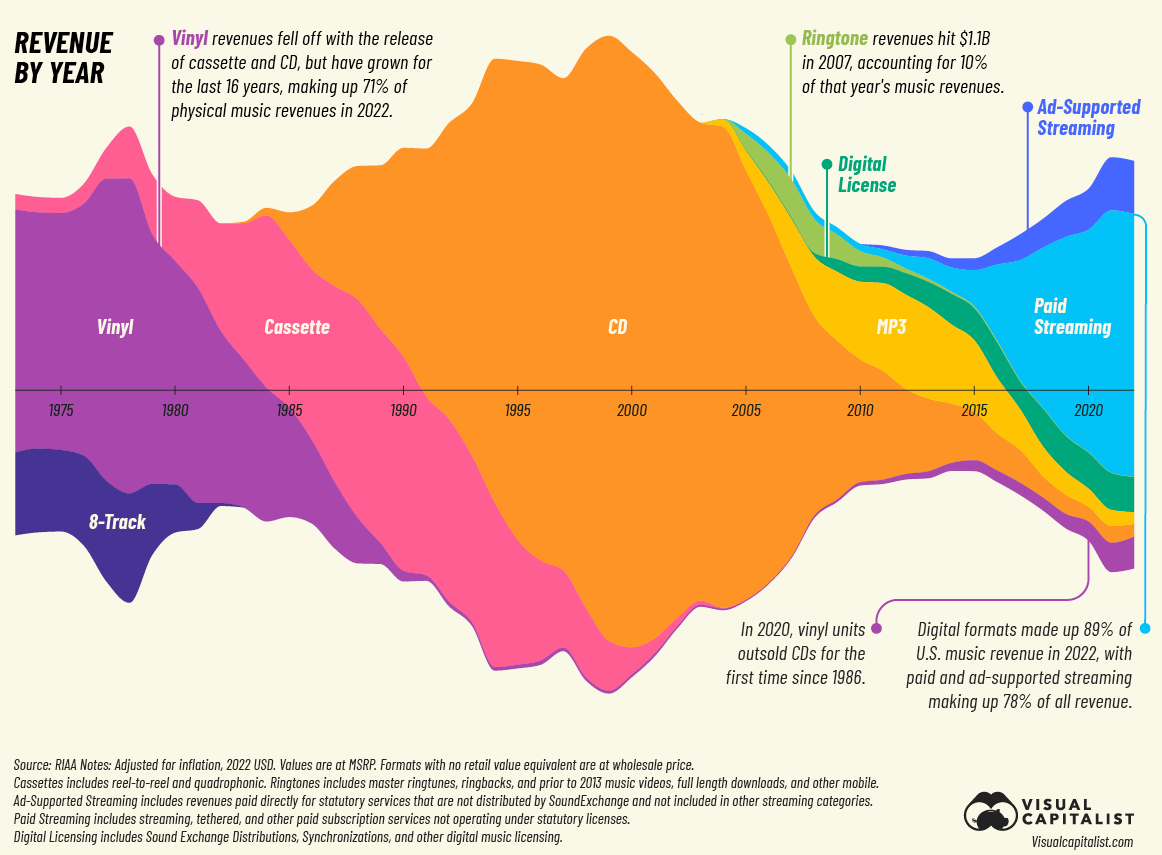
Streaming in general actually has actually been massively revenue generating for the music industry as a whole (admittedly from a low point). That’s obviously not to argue that it’s better for every artist. As with most media (YouTube, Netflix, movies), consumption follow a power law, with a few massive winners and a (very) long tail of everything else. This is obviously brilliant for Taylor Swift and not so great for your average musician trying to make ends meet.
This comes back to how flawed pay per stream is. As Matt goes on to write:
I think some people think that when you stream a song on Spotify, that increments a counter that adds $0.004 to the artist's payout, but that's not the case. Based largely on the company's overall income, they have a "pot" of money (for lack of a better word) set aside to pay out everyone on the platform every month.
For simplicity's sake, let's say that pot is $100 and there are 2 artists on the service, you and another band. Last month, you got 20 streams and they got 30 streams. That meant you accounted for 40% of the streams on the platform, and therefore you got $40, or $2/stream.
But then the next month, the other band's music goes viral and while you got the same 20 streams you did last month, the other artist got 100 streams. Now you account for 16.7% of the streams and those same 20 streams only got you $16.67, or $0.83%/stream.
There is a fixed pot of streaming revenue to share out amongst all artists and given the way music is consumed the vast majority of it goes to a very small cohort. I’m writing this in December and I imagine that everyone’s Spotify income will be massively down as listeners spend the month listening to Mariah Carey and George Michael.
Ultimately, I would suggest that Spotify is more akin to the radio than people buying CDs. It’s a distribution/publicity channel which needs to be used to build a following which you can then monetise in other ways, rather than a means to an end in itself. Even Taylor Swift still makes a huge proportion of her income from sources other than her recorded music.
One thing I always wonder about when I see Spotify hit pieces is how little blame goes to the Record Labels. They’re the one who are actually negotiating with Spotify and have artists tied into ‘unfair’ contracts. Somehow, they seem to largely escape any criticism?